THE DERANGED MORALITY. In the film, the slavers are often depicted as god-fearing men, whose cruelty is interspersed with moments horror and self-loathing.
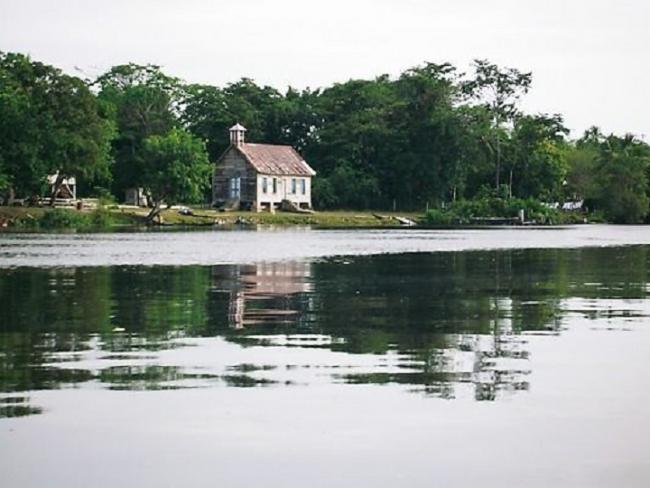
This apparent contradiction will be recognisable to students of the slave trade. Let me start here, with this picturesque photo of a church on the Berbice River (about 80 miles upstream of New Amsterdam). It is all that remains of a community of slave plantations, most of which were destroyed in the revolt of 1763. For me, it exemplifies the contradiction.
During my researches, I constantly found myself grappling with questions that are extremely difficult to answer. How did the slaving nations (in Europe and the Americas) manage to suspend a basic tenet of humanity for almost three hundred years? Was slavery a last relic of medieval thought, or was it the beginning of a modern phenomenon, where – if the price is right – anything goes?
Whatever the answers, the Guianese example is an unedifying tale. Almost everyone played their part. It began with the creation a more comfortable moral climate for the trade, in 1454, with the papal bull Dum Diversas (which encouraged the Portuguese to go out into the heathen world ‘and reduce their persons to perpetual slavery’). Once Portugal had made a virtue of slavery, the Dutch made it a business.
In 1652, they brought Guiana its first slaves. After that, everyone piled in, including the Danes and the Swedes. But it was the English who made it an industry (by 1760, they had a fleet of 146 slavers, with a capacity for 36,000 captives). No-one knows how many African lives were merged with the Guianese clay but it must be hundreds of thousands. Worse still, this savage, unbelievable trade continued in the Dutch colony until 1870, stopping just short of the Age of the Car.