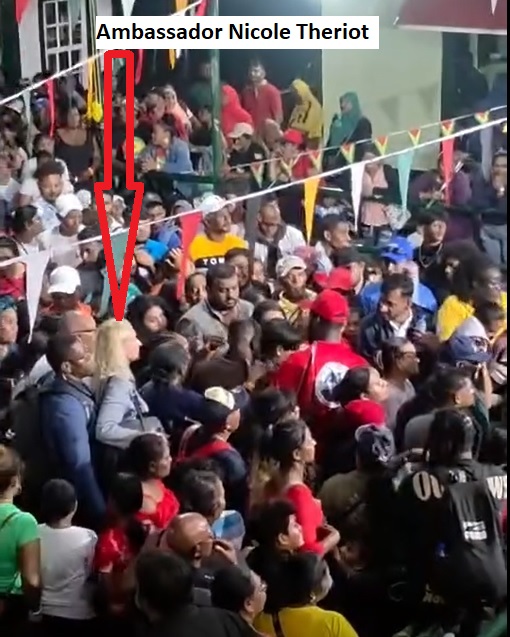
There is something deeply symbolic about diplomats and ordinary citizens all being pressed together in the same confused crowd, trying to escape a national celebration that apparently had all the exit planning of a family barbecue where someone forgot there were 400 guests and one driveway.
The reported scene following Guyana’s 60th Independence Anniversary observances on Fort Island should concern more than those who merely experienced inconvenience. According to eyewitness accounts, confusion erupted as attendees scrambled to secure transportation back to Parika after the official proceedings concluded. Among those reportedly caught in the crush was Nicole Theriot, the United States Ambassador to Guyana, who was allegedly seen navigating the same disorderly conditions alongside scores of guests attempting to board departing vessels.
That image matters.
Not because diplomats deserve privilege over citizens. They do not. If anything, the fact that the Ambassador reportedly endured the same confusion as everyone else may have unintentionally revealed something more honest about the state of public event management in Guyana than any official speech delivered earlier in the day.
National celebrations are not merely ceremonial performances. They are reflections of organizational competence, national discipline, and institutional maturity. Visitors, foreign dignitaries, investors, members of the diaspora, and citizens all quietly observe how a country handles logistics, crowd control, safety, transportation, and contingency planning. These details shape impressions long after the fireworks end and the speeches are forgotten.
Unfortunately, the transportation confusion reportedly came after another awkward moment earlier in the day, when the Golden Arrowhead allegedly failed to immediately ascend during the Independence flag-raising ceremony, delaying proceedings for more than thirty minutes. Standing alone, such incidents might be dismissed as isolated mishaps. Combined, however, they begin to suggest broader weaknesses in planning, coordination, communication, and execution.
This is not written to embarrass organizers or diminish the tremendous effort required to stage a national event of this scale. Public celebrations are extraordinarily difficult undertakings. Weather changes, equipment malfunctions, transportation bottlenecks, and human behavior all create challenges. Anyone who has ever organized even a wedding reception understands how quickly carefully laid plans can collapse once crowds begin moving. Humanity collectively invented smartphones capable of artificial intelligence, yet still cannot efficiently exit a parking lot after a concert.
Still, Guyana is no longer a small country operating outside international attention.
Today, Guyana exists under a global spotlight because of its economic growth, oil wealth, geopolitical significance, and expanding international partnerships. Events involving foreign diplomats and international guests inevitably attract scrutiny, whether fair or unfair. Images of confusion, crowd surges, or disorder can rapidly shape international perceptions in ways that undermine the very national pride such celebrations are intended to showcase.
More importantly, crowd management is not simply a matter of appearance. It is a matter of public safety.
History repeatedly shows that poorly managed exits and transportation bottlenecks can quickly become dangerous. Crowds behave differently once events conclude. Patience disappears. Fatigue increases. People begin rushing simultaneously toward limited exits or transport options. Without clear communication, structured staging, and visible coordination, confusion escalates rapidly.
Guyana must learn from these experiences rather than dismiss them.
The answer is not criticism for criticism’s sake. The answer is professionalization. Large-scale national events require integrated transportation planning, crowd-flow modeling, emergency contingency procedures, clear public communication systems, and designated protocols for VIPs, elderly attendees, and families with children. These are not luxuries reserved for wealthy nations. They are standard requirements for responsible event management.
As Guyana continues to host increasingly prominent international events, expectations will continue to rise. That reality cannot be avoided.
The irony is that Guyana’s Independence celebrations were intended to symbolize national progress, confidence, and unity. In many ways they still did. But moments of disorder, however unintended, remind us that development is not measured only by economic statistics, new buildings, or international headlines. It is also measured by systems, preparation, competence, and the ability to manage success responsibly.
A nation celebrating sixty years of independence should aspire not merely to host grand events, but to execute them with the professionalism worthy of the country Guyana is becoming.