

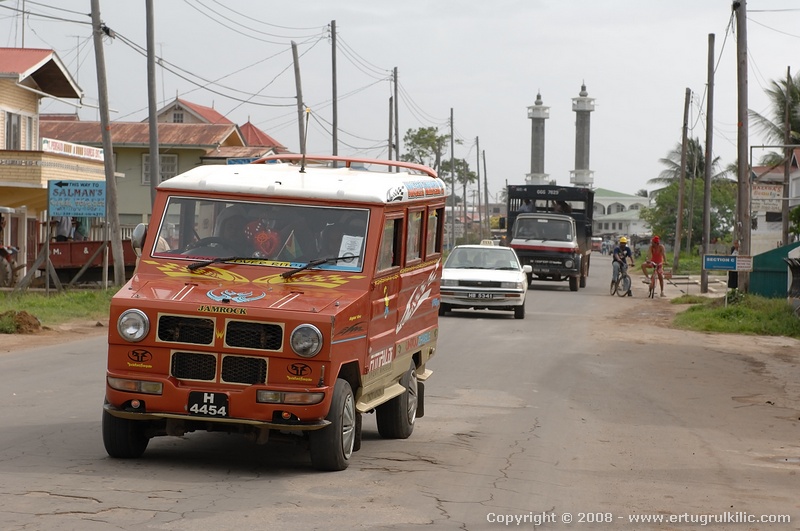
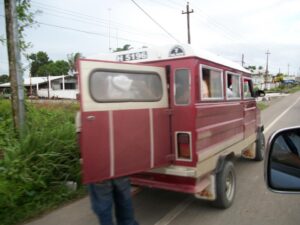
There was a time when hearing someone say, “The Tapir coming!” meant it was time to get ready for a ride. Long before imported minibuses dominated Guyana’s roads, the Tapir was one of the country’s most recognizable forms of public transportation and a symbol of local ingenuity.
For thousands of Guyanese who grew up during the 1970s, 1980s and even into the early 2000s, the Tapir was much more than a vehicle. It represented an era when Guyana sought to manufacture products locally and build industries capable of serving the nation’s needs.
The story of the Tapir began in 1975 at Associated Industries Limited (AINLIM), now known as Massy Motors Guyana. Engineers, fabricators and mechanics worked together to design and assemble what would become Guyana’s first locally manufactured passenger vehicle. Built primarily for public transportation, the compact vehicle was intended to provide an affordable and practical solution for both operators and passengers.
Constructed with a steel body and powered by components imported from Britain, including a Vauxhall Viva engine, the Tapir was simple, durable and relatively inexpensive to maintain. While it lacked many of the comforts of modern minibuses, it proved well suited to Guyana’s road conditions of the time.
Its unmistakable box-like shape quickly became part of the country’s landscape. Designed to carry about seven passengers, the Tapir became especially popular in Berbice, where it served communities along the Corentyne coast for decades. For many residents, it was the vehicle that carried children to school, workers to their jobs and families to markets, weddings and religious services.
The Tapir’s development also reflected the industrial ambitions of Guyana during the 1970s. The country was encouraging local manufacturing, reducing dependence on imports and creating employment through domestic production. The successful introduction of a locally built passenger vehicle demonstrated that Guyanese technicians possessed the skills to design, fabricate and assemble complex products using locally available resources combined with imported mechanical components.
The road to success was not without tragedy.
During testing of one of the early prototypes, employee Terrence “Terry” Marques lost his life in an accident. The incident deeply affected the development team, but work continued, and production moved forward. The sacrifice remains an important, though often overlooked, part of the Tapir’s history.
Over the years, several variations of the Tapir were developed, including hatchback, pickup and delivery van versions. Approximately 840 units were ultimately produced before manufacturing ended. Many continued operating for decades, a testament to their rugged construction and the dedication of mechanics who kept them on the road long after production ceased.
By the late 1980s and into the 1990s, imported Japanese minibuses began replacing the Tapir across much of Guyana. These newer vehicles carried more passengers, offered greater comfort and were easier to acquire as import restrictions eased. The once familiar Tapir gradually disappeared from most routes, although a handful continued operating in Corriverton and surrounding communities well into the 2000s.
Today, surviving Tapirs are rare. Those that remain are cherished by owners and transport enthusiasts who recognize their place in Guyana’s industrial heritage. They stand as reminders of a period when Guyana dared to manufacture its own vehicles and proved that local innovation could compete with imported products.
The Tapir deserves recognition alongside other achievements in Guyana’s manufacturing history. It was more than a means of transportation. It was evidence of what Guyanese engineers, welders, mechanics and craftsmen could accomplish when given the opportunity.
As Guyana continues its rapid economic transformation, preserving the history of the Tapir serves another purpose. It reminds younger generations that innovation did not begin with the oil industry. Decades before offshore discoveries transformed the economy, Guyanese were already building machines that carried a nation forward.
The Tapir may no longer dominate the roads, but its legacy continues to travel through the memories of those who rode in one, built one, or proudly watched a uniquely Guyanese vehicle become part of the country’s history.







I’ve never been able to
I’ve never been able to travel in one of these but I really do need to look it up. Do they still use them?