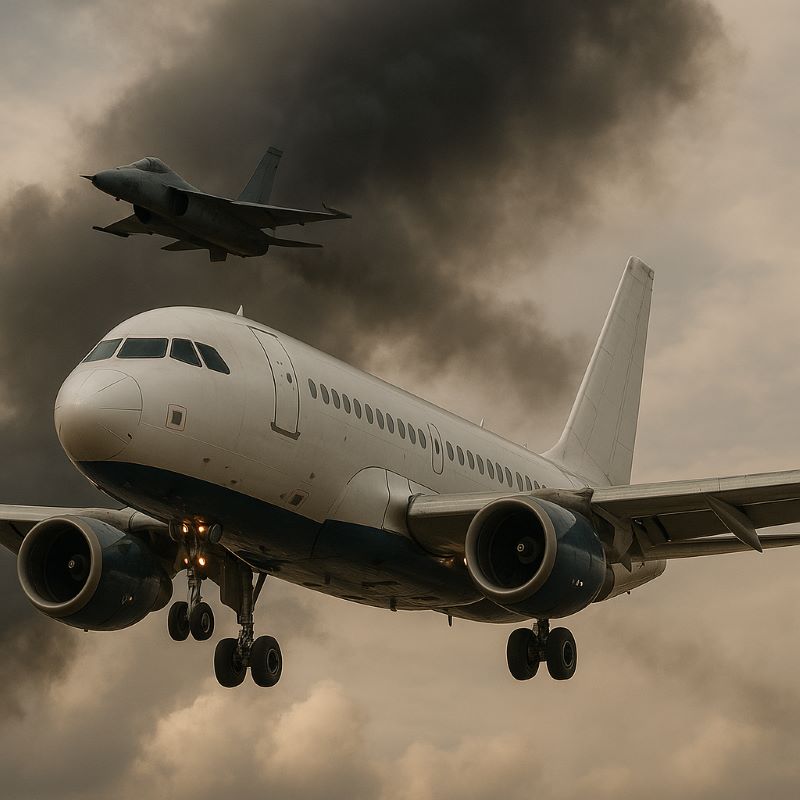
The near-miss between a JetBlue commercial aircraft and a United States military aircraft on December 14, 2025, near the Caribbean country of Curaçao, serves as another warning about a problem that governments claim to have under control, but they do not. History is littered with casualties. When military assets operate on high alert in civilian airspace, ordinary people pay the price.
History shows that when military engagement brings down a civilian aircraft, officials’ language is swift. They call it an inadvertent action, they say it was an accident, they insist it was unintended. None of those words matter to the families burying loved ones. The outcome is always the same: innocent passengers and crew die, and fear spreads far beyond the wreckage.
This fear does not affect policymakers and ordinary citizens equally. Those who live behind layers of security, who fly in protected corridors, and who operate within restricted airspace rarely experience the anxiety that ordinary citizens carry onto every commercial flight. For millions of people, flying is not optional; it is work, family, or survival. Each headline about a close call or a shootdown adds another layer of dread to an already tense experience. For many governments, aviation is an economic necessity and a means of maintaining solvency.
Aviation has become safer over the decades as a result of hard lessons, technological improvements, and data sharing. Accident investigations have led to fundamental changes in aircraft design, training, and air traffic control. The industry has done its part. Yet governments continue to create conditions in which civilian aircraft share the skies with military systems that operate by different rules, for example, flying in commercial airspace without their transponders turned on, thereby making them invisible to other aviation traffic.
As recently as January 29, 2025, an American Airlines Flight 5342 was involved in a midair collision with a United States Army Sikorsky UH-60 Black Hawk helicopter over the Potomac River in Washington, D.C., resulting in the loss of 67 lives, including three persons aboard the helicopter. The record is clear: military aircraft operating in the civilian airspace under different rules have produced multiple civilian shootdowns and midair collisions for decades around the world.
The danger multiplies when combined with terrorism, bombings that are real and imagined, and hijackings. Threats, real and imagined, take a psychological toll that statistics cannot capture. Pilots and cabin crews carry this burden. Passengers carry it. Families waiting at arrivals carry it.
Citizens across the world must ask their leaders for something radical and apparently challenging: to find alternatives to military escalation. This is not an endorsement of strongmen or reckless leaders. It is not in support of President Nicolás Maduro, who himself engages in the same coercive behavior and has been known to take aggressive actions, such as attempting to seize two-thirds of Guyana in a land dispute that was settled in 1899. Rejecting one form of aggression does not require accepting another.
The situation in the Caribbean serves as an example of how quickly civilians become collateral damage. Trinidad and Tobago face severe crime pressures and a large influx of Venezuelans fleeing economic collapse. Prime Minister Kamala Persaud has turned to cooperation with the United States military as a response. This decision places her country closer to the line of confrontation. In any direct clash between Venezuela and the United States, Trinidad becomes exposed. So do its citizens, as well as every aircraft passing through the region.
Militarized skies not only threaten planes; they threaten confidence in global travel, regional stability, and basic civilian safety. A near miss is not a success story. It is evidence of how close the system is to catastrophe.
Governments may insist that these risks are manageable. However, history disagrees. Each incident, each apology, each investigation arrives too late for those already lost. If leaders truly value civilian life, they must stop treating commercial airspace as an acceptable backdrop for military posturing. Ordinary people deserve skies that are dull, predictable, and safe. That should not be an unreasonable demand.