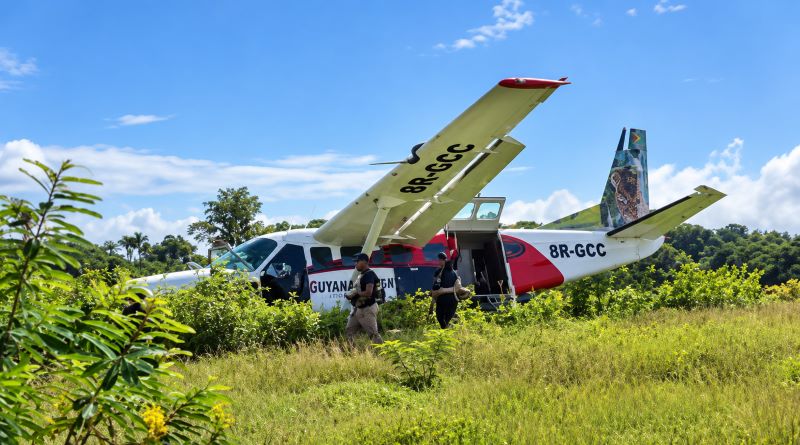
A Trans Guyana Airways Cessna 208B Grand Caravan, registration 8R-GCC, was forced off the runway while landing at Mabaruma Aerodrome on Thursday, September 17, 2026, after an animal entered the runway, according to a statement issued by the airline.
Trans Guyana Airways said the incident caused “considerable damage” to the aircraft and endangered passenger safety. The company’s September 18, 2026 press release did not identify the type of animal involved, provide the number of passengers and crew aboard, or report any injuries.
The runway excursion has placed renewed attention on a problem that Trans Guyana Airways says it had formally raised with the Guyana Civil Aviation Authority months before Thursday’s accident: animals, wildlife and other incursions at Guyana’s hinterland aerodromes.
The documents released by the airline indicate that concerns about Mabaruma were neither new nor confined to a single incident.
Warnings dating back to June
In a June 16, 2026 safety report to the Director General of the Guyana Civil Aviation Authority, Trans Guyana Airways warned of what it described as an “escalating trend” of runway incursions, malicious interference and infrastructure failures at interior airstrips.
The report documented eight incidents between May 21 and June 15 at Lethem, Mabaruma and Imbaimadai.
Among them was a June 9 report of cows grazing alongside the runway at Mabaruma. The photographic evidence attached to the report includes two images on page five specifically captioned “Cows grazing at Mabaruma,” showing cattle immediately adjacent to the airstrip.
Other incidents documented by TGA included horses on the runway at Lethem, a missed approach because of a horse, departure delays caused by horses, cattle near the Imbaimadai runway, a bag containing a dead dog placed on the Lethem runway, rocks deliberately positioned on the runway, and a damaged perimeter fence.
The June report characterized the obstructions as presenting a high risk of aircraft damage, loss of control or engine ingestion, particularly during takeoff and landing. TGA recommended security inspections, repairs and reinforcement of perimeter fencing and access gates, intervention by local authorities and stronger pre-arrival runway inspection procedures.
The airline concluded that the situation had reached what it called a “critical threshold.”
Mabaruma warning issued eight days before accident
More significantly, Trans Guyana Airways sent another safety report to the GCAA on September 9, just eight days before the runway excursion involving 8R-GCC.
That report focused specifically on increased wildlife activity and bird and vulture hazards at interior airstrips, identifying Mabaruma as the location “most seriously affected.”
TGA reported that during the preceding four weeks there had been at least four reported bird strikes involving its aircraft operating into Mabaruma and other locations. It also reported at least one missed approach after vultures were observed occupying the runway while an aircraft was approaching, forcing the crew to go around and make another landing attempt.
The airline warned that vultures gathering on or near runways created the potential for multiple-bird strikes during the critical takeoff and landing phases.
TGA also raised a broader infrastructure concern. Its September report said interior airstrips, including Mabaruma, generally had limited or no wildlife-control infrastructure, such as perimeter fencing, deterrent systems or dedicated ground personnel.
According to the airline, this meant individual aircraft operators had limited ability to manage the hazard themselves.
TGA told the GCAA that it had instructed its flight crews to exercise heightened vigilance at Mabaruma and other affected airstrips and was reviewing its internal reporting and go-around procedures.
However, the airline argued that the underlying problem required action at the airport-authority level.
Among its recommendations were an assessment of wildlife attractants around Mabaruma, including waste disposal sites, abattoirs, drainage and agricultural activity; stronger wildlife-management measures; runway inspections before scheduled operations; active deterrence of vultures and other wildlife; and a broader wildlife-hazard assessment of Guyana’s interior aerodrome network.
TGA links accident to longstanding concerns
In its statement following Thursday’s accident, Trans Guyana Airways directly connected the runway excursion with its earlier warnings.
The airline said animal and human intrusion at government-owned and operated hinterland airports represented a continuing threat to commercial and private aircraft using those facilities.
TGA specifically pointed to its correspondence of June 16 and September 9 to the GCAA, releasing both documents publicly following the Mabaruma accident.
Taken together, the documents establish a timeline that will likely become important in determining what occurred at Mabaruma and whether the accident could have been prevented.
On June 9, TGA documented cattle grazing alongside the Mabaruma runway. On June 16, it formally reported animal incursions and other runway hazards to the GCAA. On September 9, it issued another warning, this time identifying Mabaruma as particularly affected by wildlife activity and requesting specific mitigation measures. Eight days later, according to the airline, 8R-GCC was forced off the Mabaruma runway because of an animal incursion.
Questions now facing aviation authorities
The documents supplied by TGA establish that the airline reported the hazards. They do not establish what action, if any, the GCAA, airport management or other government agencies took in response before the September 17 accident.
That distinction is important.
The available documents also do not identify the animal involved in Thursday’s incident, explain exactly how it entered the operational area, establish whether the runway was inspected immediately before 8R-GCC landed, or indicate whether fencing or other wildlife-control measures were in place and functioning at the time.
Those issues will require answers from the GCAA and the agencies responsible for operating and maintaining Mabaruma Aerodrome.
Among the central questions are whether the June and September warnings resulted in a formal hazard assessment, whether corrective measures were ordered, whether runway inspections were increased, and what procedures existed for keeping animals and wildlife away from the runway.
The condition of 8R-GCC and the circumstances of the excursion will also require technical examination before conclusions can responsibly be drawn about the accident sequence.
Trans Guyana Airways said it remains available to work with the GCAA, other licensed aircraft operators and the Aviation Operators’ Association of Guyana to address the problem urgently.
For Guyana, where interior aviation provides an essential transportation link to communities that cannot depend on the country’s road network, Thursday’s accident raises a larger safety question: whether development of hinterland aviation infrastructure is being accompanied by adequate runway security, wildlife management, inspections and operational oversight.
The September 17 runway excursion did not create those questions. Trans Guyana Airways’ own correspondence shows that some of them had been formally raised months earlier.
Trans Guyana Airways (TGA) Press Release: RE Accident at Mabaruma Airstrip 18.09.26
Trans Guyana Airways (TGA) – Flying wildlife occurrences at Aerodromes
Trans Guyana Airways (TGA) Report to the GCAA reference RWY Incursions by Animal