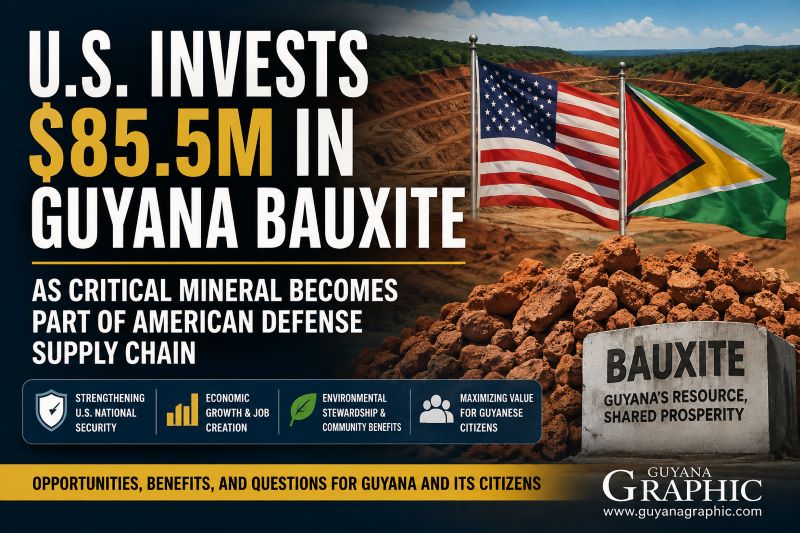
GEORGETOWN, Guyana, August 8, 2026 – The United States Department of War has announced an $85.5 million equity investment agreement with Strategic Bauxite USA, LLC, aimed at securing a critical supply of high-grade bauxite from Guyana and reducing American dependence on China and Chinese-controlled sources.
The announcement, made on August 7, represents a significant development in the economic and strategic relationship between Guyana and the United States.
According to the Department of War, the $85.5 million investment through its Industrial Base Analysis and Sustainment program will be combined with an additional $64.5 million in private-sector investment, bringing the combined commitment to approximately $150 million. The money will be used to acquire and expand the First Bauxite mine in Guyana, establish additional calcination capacity for primary processing, and support a subsequent project to construct a brown-fused alumina facility in the United States. (U.S. Department of War)
The implications extend well beyond another foreign investment in Guyana’s mining sector and this project places Guyana directly within the United States’ national security supply chain.
Why Guyana’s Bauxite Matters to the United States
Refractory-grade bauxite is a specialized, high-purity material capable of producing products that withstand extreme temperatures. The Department of War says the material is required for heat shields, thermal barriers, turbine engines and components used in guided missiles, rockets, military aircraft and space systems. It also has important civilian applications in steel and aluminum production, industrial furnaces and energy infrastructure.
The United States currently depends heavily on imported refractory-grade bauxite, much of it coming directly from China or Chinese-owned entities and Washington now wants to change that.
Once the Guyana-linked project becomes fully operational, the Department of War expects it to supply 100 percent of U.S. military demand for brown-fused alumina and 100 percent of total U.S. demand for refractory-grade bauxite.
That is an extraordinary strategic role for Guyana and means that a mineral extracted from Guyanese soil could eventually become essential to America’s military readiness and important sections of its industrial economy.
The U.S. government is therefore no longer viewing Guyana solely through the prism of oil, regional diplomacy or the Venezuela border controversy. Guyana’s mineral resources are increasingly becoming part of America’s broader national security calculations.
The Benefits for the United States
For Washington, the advantages are clear. The United States reduces its exposure to China for a strategically important mineral. It moves part of a critical supply chain into the Western Hemisphere. It gains access to a country with which it already has expanding diplomatic, economic and security relations.
Assistant Secretary of War for Industrial Base Policy Michael Cadenazzi said the agreement is intended to ensure that critical materials within the Western Hemisphere remain in supply chains that protect the United States and its allies.
That statement deserves attention in Guyana. This is not simply an American company purchasing Guyanese ore on the international market. The U.S. government itself is investing public money because it considers the resource important to national defense.
Washington also gains diversification. Any serious confrontation involving China could expose vulnerabilities in supply chains for minerals, electronics, batteries, rare earths and other materials required by modern military and industrial systems. Establishing a reliable source in Guyana reduces some of that risk.
What Guyana Could Gain
For Guyana, the potential benefits are substantial. First Bauxite operates the Bonasika mines between the Essequibo and Demerara Rivers. The company says the operation has a mine life exceeding 20 years and contains additional mineral resources, including high-purity quartz sand and clays. (First Bauxite)
Expansion could mean additional employment, training, infrastructure, transportation activity, contracts for Guyanese businesses and increased government revenues and there is another potentially more important benefit. Guyana now has leverage.
If a mineral located beneath Guyanese territory becomes essential enough for the United States government to invest directly in securing its supply, Guyana should negotiate from the position of a strategic supplier rather than simply that of a developing country exporting raw material. The country should seek technology transfer, specialized training, scholarships, engineering development, infrastructure improvements and opportunities for Guyanese companies to participate throughout the supply chain.
Guyana should also insist that as much processing and value creation as economically practical takes place inside Guyana. That distinction matters.
A country can possess enormous natural resources and still capture only a fraction of their ultimate economic value if it exports raw materials while processing, manufacturing, intellectual property and advanced industrial activity occur elsewhere. Guyana has lived through that economic model before.
The Question Guyanese Should Be Asking
The Department of War announcement therefore raises an important question: How much of the approximately $150 million investment will actually remain in Guyana?
The American release states that funding will acquire and expand the Guyanese mine, develop new calcination facilities for primary processing, and contribute to a subsequent brown-fused alumina facility in the United States.
The distribution of those investments matters. Guyanese citizens should know how much money will be invested directly in Guyana, how many permanent jobs will be created, what wages will be paid, what taxes and royalties will accrue to the state, what environmental obligations apply, and what percentage of goods and services will be purchased from Guyanese businesses.
They should also know what commitments have been made concerning reclamation and environmental restoration after mining.
Those are not anti-investment questions. They are the questions responsible governments ask when managing resources that belong to their citizens.
A Familiar Risk for Guyana
Guyana must be careful that history does not repeat itself.
For generations, developing countries have exported raw commodities while industrialized countries captured much of the greater value from refining, manufacturing and distribution. Bauxite is particularly relevant to that history.
Guyana has been a major bauxite producer for more than a century, yet the country never developed the scale of downstream aluminum manufacturing that might have transformed the mineral into a much larger domestic industrial sector.
Oil has now created similar debates about local content, refining, petrochemicals, skills development and how much economic value remains inside Guyana. The same discussion should begin immediately with this bauxite expansion.
If Guyana possesses a mineral important enough to become part of the American defense industrial base, the objective should not simply be to dig it from the ground and ship it overseas. The objective should be to convert the resource into long-term Guyanese economic capacity.
Environmental and Community Concerns
Expansion of mining also brings environmental consequences. Mining can affect forests, waterways, wildlife habitats and nearby communities. Larger operations can increase road and river traffic and require expanded waste-management and land-reclamation programs.
The investment therefore requires strong and independent environmental oversight. Guyana should require publicly understandable environmental monitoring, reclamation obligations, water-quality testing and regular disclosure of compliance.
Communities affected by mining should also have a meaningful role in the process. The economic argument for development becomes considerably weaker if national benefits arrive at the expense of communities located closest to the resource.
Guyana’s Strategic Position Is Changing
There is also a geopolitical dimension that Guyanese policymakers cannot ignore.
Guyana already supplies significant quantities of petroleum to international markets and hosts one of the world’s most important emerging offshore oil developments. Now another Guyanese natural resource is being incorporated into an American strategic supply chain. At the same time, Guyana has strengthened security cooperation with Washington.
In March, Guyana joined the U.S.-led Americas Counter-Cartel Joint Security Declaration, which calls for increased cooperation on border security, narcotics trafficking, transnational crime and protection of critical infrastructure. (DPI) The relationship is therefore developing simultaneously across energy, minerals, defense, diplomacy and security.
That can benefit Guyana enormously but it also requires sophisticated diplomacy.
Guyana has relationships with the United States, China, Canada, the United Kingdom, the European Union, Brazil, India, CARICOM and other international partners. The country should protect its sovereign ability to work with multiple partners while recognizing that its resources increasingly carry strategic importance to major powers.
What This Means for Ordinary Guyanese
For the average Guyanese citizen, announcements involving tens of millions of U.S. dollars can sound impressive while having little immediate connection to daily life. That is precisely why the measurements of success must change.
The real test should be whether investments such as this produce better-paying jobs, technical careers, apprenticeships, contracts for local businesses, improved infrastructure and greater national revenues.
- Guyana should publish the economic terms governing the operation to the greatest extent permitted by law.
- Citizens should be able to determine what Guyana receives for every tonne of bauxite extracted.
- They should know what tax concessions have been granted.
- They should know how many Guyanese workers will be employed.
- They should know how environmental liabilities will be funded.
- They should know whether processing facilities can eventually be expanded in Guyana.
- And they should know whether the government has negotiated meaningful opportunities for Guyanese engineers, geologists, technicians, contractors and businesses to participate in higher-value activities throughout the industrial supply chain.
A Significant Opportunity, if Managed Properly
The U.S. announcement should be welcomed as further evidence of Guyana’s growing economic and strategic importance. However, the true measure of success will not be the size of the investment alone, but how effectively Guyana converts this opportunity into lasting benefits for its citizens.
A major American government investment linked directly to national defense represents confidence in Guyana’s resources and the stability of the bilateral relationship. But Guyana should not measure success by the size of the announcement.
The United States is pursuing a clearly defined national interest. It wants a secure supply of a critical mineral, reduced dependence on China and greater resilience for its defense industrial base.
There is nothing improper about that. Governments are expected to pursue the interests of their citizens, however Guyana must demonstrate the same discipline.
Its objective should be equally clear: obtain maximum sustainable economic value from a finite national resource while protecting the environment, creating skilled employment and ensuring that Guyanese citizens receive a fair return.
The United States has identified what it needs from Guyana. Guyana must now clearly define what Guyana and its citizens expect in return.
Source: U.S. Department of War, August 7, 2026 press release